
Main Article Headline |
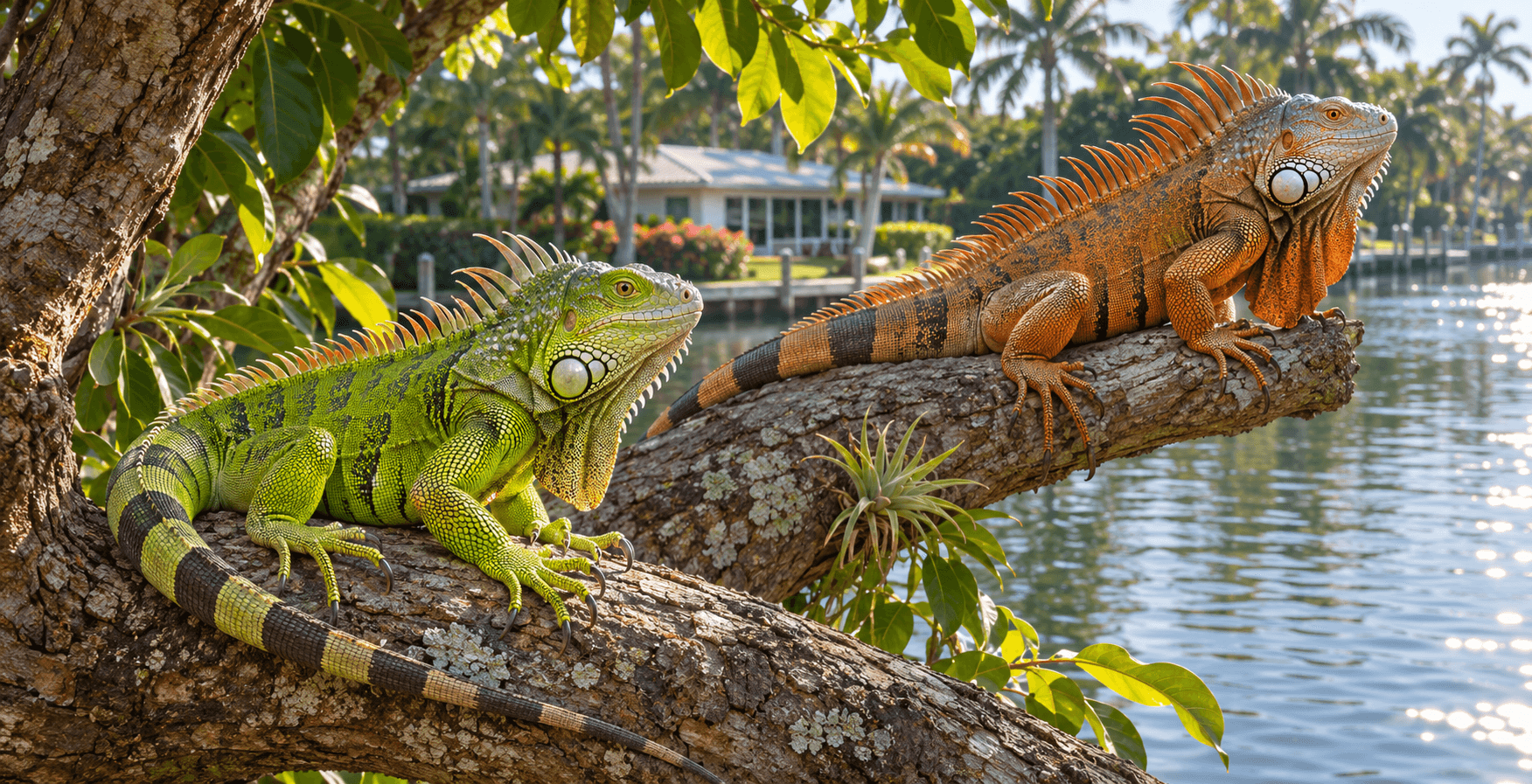
Along Broward’s canals, green iguanas spend their days basking and often sleep in the branches overhead. Where they settle for the night helps explain one of South Florida’s strangest cold-weather sights. |
Interesting South Florida Fact
There’s foliage to eat for dinner, a branch to sleep on and water within diving distance if something startles it. It takes an unusually cold night to turn that perch into a problem.
When an iguana gets cold enough to lose its grip, the first sign of trouble may be a large lizard lying perfectly still beneath the tree.
That’s the story behind the phrase lluvia de iguanas, or “raining iguanas,” which turned up in Spanish-language headlines ahead of South Florida’s November 15 cool spell.
If you wondered whether to look up on your morning walk, the local forecast offered some perspective. Sunday’s predicted lows were in the 50s, and CBS Miami meteorologists considered widespread falls unlikely.
A deeper chill, especially one that lingers into the 40s, is a different story.
So, what happens to an iguana on a cold night?
A green iguana is an ectotherm. It draws much of the heat it needs from its surroundings. A sunny canal bank gives it a place to warm up during the day. Its choice of sleeping spot matters after sunset, too.
University of Florida researchers describe green iguanas sleeping in trees, rock crevices and burrows they dig themselves. Only some of those beds come with a drop to the ground.
During a sustained chill, an iguana can enter a state called torpor. Its muscles respond so poorly that its feet can release the branch. On the ground, the animal may look lifeless, belly up. But, as its body warms, it can regain enough strength to scramble away.
There’s no single temperature at which every iguana falls. Both the animal’s size and the length of time it spends in the cold affect how it fares.
Why Broward’s canals suit them so well
On a warm day, the more revealing thing to watch is what an iguana does when startled. This tree-climbing reptile is also a capable swimmer. One moment it may be perched above a canal, and the next it can dive into the water to escape.
South Florida’s connected waterways give iguanas routes into new neighborhoods, while canal banks offer places to dig burrows. Those tunnels can eventually undermine the banks and nearby seawalls.
Their appetites offer another surprise. Leaves, flowers and fruit make up much of a green iguana’s diet, as anyone guarding a flowering garden might suspect.
But researchers have also documented both young and adult iguanas eating tree snails. It’s an easy detail to miss when watching one bask, and one reason this familiar Broward resident matters to the wildlife already living here.
Florida classifies the green iguana as invasive, unfortunately. Green iguanas may be a familiar sight along Fort Lauderdale’s canals, but they’re newcomers to Florida, people brough them here.
That warm-weather ancestry helps explain why a sunny afternoon on a Broward canal suits them so well, and why a prolonged cold snap can leave them struggling to hold on to a branch.
If you find one on the ground
Give it room. The Florida Fish and Wildlife Conservation Commission advises leaving a cold-stunned iguana out of your car and home.
An animal that barely moves outdoors can revive as it warms and defend itself with its teeth, claws or powerful tail. On a chilly morning, the best way to observe this particular piece of South Florida wildlife is from a little distance. |
0 Comments
Join the conversation
Be the first to comment
Share your thoughts above.