
Main Article Headline |
From its beginnings at Lake Mabel to today’s cruise terminals, cargo docks and fuel operations, Port Everglades has helped shape the way Broward County lives, works and travels. |
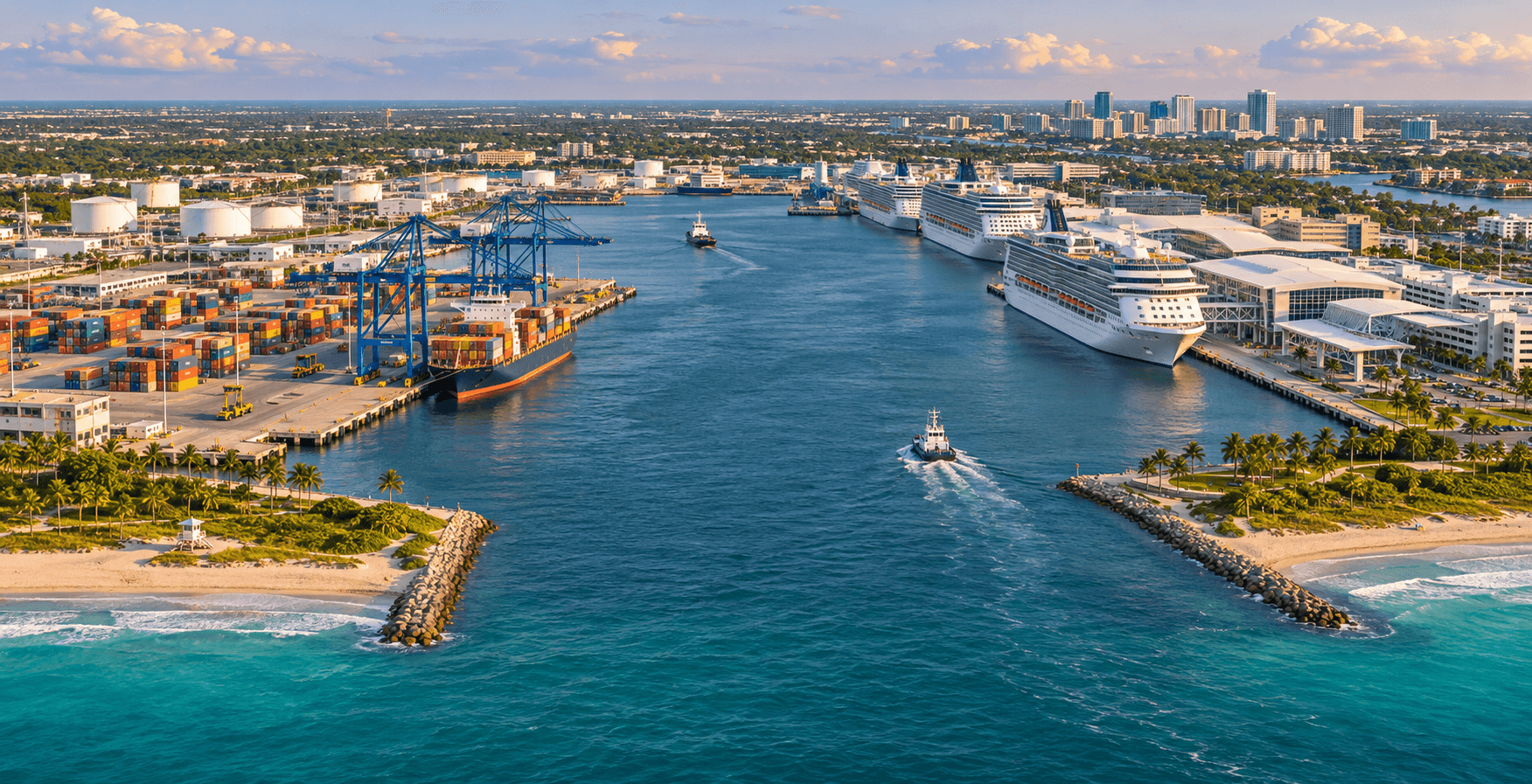
A cruise ship heading toward the Atlantic is one of Fort Lauderdale’s most memorable sights. Behind that departure, however, lies a much larger story.
Port Everglades is also a working gateway for international trade and a major distribution point for the fuel that keeps South Florida moving. Its three main businesses: cruise, cargo and energy, connect the waterfront to everyday life across the region.
The port’s transformation began with a relatively simple ambition: create a deepwater harbor that would bring commerce and opportunity to a growing community. Nearly a century later, that ambition has developed into an operation serving travelers, shipping companies and businesses far beyond Broward County.
Before the Port, There Was Lake Mabel
The waterfront that became Port Everglades originally included Lake Mabel, a shallow coastal body of water separated from the Atlantic Ocean by a low sand ridge.
Creating a commercial harbor required excavating the lake and establishing a navigable connection to the sea. According to the U.S. Army Corps of Engineers, the initial construction took place between 1925 and 1928 through cooperation between Hollywood, Fort Lauderdale and private investment.
Hollywood founder Joseph W. Young played a central role in advancing the harbor project during the 1920s. He recognized that ocean access could help support the development of the surrounding communities. The project linked the ambitions of two neighboring cities whose futures would become closely tied to tourism, transportation and trade.
1928: The “Wedding of the Waters”
Port Everglades traces its founding to February 22, 1928, when the harbor was dedicated in a ceremony known as the “Wedding of the Waters.” The name celebrated the connection between the inland harbor and the Atlantic Ocean.
The dedication marked the beginning of the port’s public story, but commercial operations followed later. The port’s official history identifies November 23, 1928, as the arrival date of its first commercial ship. That distinction helps explain why a harbor’s ceremonial opening and its working beginnings do not always fall on the same day.
The familiar name came afterward. In 1930, a contest organized by local women’s clubs helped select Port Everglades, replacing the earlier Bay Mabel Harbor name.
Building a Working Harbor
During the early 1930s, the port began developing the business relationships needed to turn a newly excavated harbor into a useful commercial destination.
Warren T. Eller became its first port manager in 1932. He recognized the value of the surrounding open land for storing large shipments and pursued businesses handling petroleum products, lumber, cement and scrap metal. That strategy helped establish the industrial side of the port, a role that remains essential today.
Federal involvement also helped sustain the harbor. The River and Harbor Act of 1930 brought federal maintenance responsibilities to the locally constructed project. Maintaining navigable channels through dredging became a continuing part of keeping the port operational.
Wartime Service and the Rise of Passenger Travel
In the 1940s, Port Everglades devoted a significant portion of its resources to military operations. Its history therefore includes service during wartime as well as the development of commercial shipping.
By the 1950s, the port was receiving ships on around-the-world cruise itineraries. A particularly welcoming local tradition developed: members of the Fort Lauderdale Rotary Club greeted arriving passengers with Florida orange juice. Harbor support services grew too, with full tugboat service beginning in 1958.
Those early passenger visits helped establish a relationship between the port and the region’s visitor economy that would expand dramatically in later decades.
What Happens at Port Everglades Today?
The modern port operates around three major activities, each with a different purpose.
1. Cruise Travel
For many residents and visitors, cruising is the port’s most recognizable business. Port Everglades serves as a departure and arrival point for cruise vacations, with terminals handling the movement of passengers and their luggage.
A defining milestone came in 2009, when Cruise Terminal 18 opened in time for Royal Caribbean’s Oasis of the Seas. The terminal reflected a major change in the cruise industry: larger vessels required facilities capable of handling thousands of travelers efficiently.
The scale of that business is evident in the port’s preliminary fiscal year 2025 results, which recorded approximately 4.77 million cruise passenger movements. This is a measure of port activity and should not be interpreted as 4.77 million different vacationers.
2. Cargo and International Trade
Cargo operations connect South Florida businesses with overseas markets, particularly in the Caribbean and Latin America. Containers move between ships and land transportation, forming part of the supply chains that bring goods into the region and carry exports outward.
For fiscal year 2025, Port Everglades reported a record 1,167,552 TEUs in its preliminary results. A TEU, or twenty-foot equivalent unit, is a standard measure of container capacity; a forty-foot container represents two TEUs.
Rail has become an increasingly useful part of this operation. Florida East Coast Railway’s 43-acre Intermodal Container Transfer Facility, which began operating in 2014, improved transfers between ships and trains. Its proximity to the docks reduced the need to move containers by truck to a separate, more distant rail terminal.
3. Fuel and Energy Distribution
The energy business may attract less attention than the cruise ships, but its reach extends throughout South Florida. Port Everglades receives and distributes gasoline, diesel and jet fuel.
According to the port’s June 2026 economic-impact announcement, its fuel network serves 12 counties and five international airports. That makes the harbor part of the infrastructure supporting road travel, deliveries and aviation across the region.
How the Port Has Adapted to Larger Ships
As ships and shipping methods changed, Port Everglades had to change with them. Modernization has involved passenger terminals, rail connections, cranes and additional space for cargo vessels.
One of the largest projects has been the Southport Turning Notch Extension. It lengthened the cargo-ship turnaround area from approximately 900 feet to 2,400 feet, creating room for five additional cargo berths. Broward County’s fiscal year 2024 financial statements reported that the project was substantially complete in November 2023.
The expansion illustrates how a port evolves: accommodating larger ships involves changes to the water basin, docks and equipment together. Additional shoreline alone cannot provide the capacity that modern vessels require.
An Economic Role That Reaches Beyond the WaterfrontPort activity supports a network of businesses involved in transportation, tourism, freight handling, distribution and related services.
A Martin Associates study commissioned by the port estimated that fiscal year 2025 activity generated approximately $48.3 billion in statewide economic activity and supported nearly 300,000 Florida jobs. Those figures describe a broad economic footprint, including businesses that use the goods and fuel moving through the port; they are not counts of people employed on port property.
The report also expanded its accounting of energy-related activity. Consequently, the increase over earlier estimates should not be read entirely as new business growth.
Port Everglades operates as a self-supporting enterprise fund of Broward County government. The port states that it does not rely on local tax dollars for operations or capital improvements.
Planning for Growth Along a Living Coast
Expanding a seaport also brings environmental responsibilities. The waters and shorelines around Port Everglades include mangroves, seagrasses, coral habitat and wildlife.
As part of the Southport expansion’s environmental mitigation, the port developed approximately 16.5 acres of mangrove enhancement, replacing an affected conservation area with a larger restored habitat. Related work at West Lake Park has included habitat creation, restoration and protection.
A separate harbor deepening and widening project is intended to improve access for larger vessels. The port’s development information identifies that project as being in the preconstruction engineering and design phase. Its environmental considerations include coral, seagrass, mangroves and marine wildlife.
A Different Way to See the Harbor
Port Everglades’ history brings together several chapters of Broward’s development: an ambitious harbor project, early commercial shipping, military service, passenger travel and the growth of international supply chains.
Today, the cruise ships are the most visible expression of that history. The cargo docks, rail connections and fuel operations reveal the rest of it. Together, they show how a former coastal lake became a working connection between South Florida and the wider world.
To learn more, explore the official Port Everglades website and its port history page. |
0 Comments
Join the conversation
Be the first to comment
Share your thoughts above.